
 As the federal government shutdown continues, millions of families across the country are facing uncertainty about how they’ll access food in the coming weeks.
Here’s what this means for Supplemental Nutrition Assistance Program (SNAP) recipients—particularly here in Massachusetts and across the Southcoast—and what you can do to help.
What’s Happening
When Congress fails to pass a budget, the federal government shuts down.
Many programs—including food assistance—rely on that annual funding to operate.
SNAP, which provides grocery benefits to low-income individuals and families, is one of the programs most directly impacted.
This is a man-made crisis and preventable. The Trump Administration plays a critical role in resolving the shutdown, and the U.S. Department of Agriculture (USDA) can release contingency funds to keep benefits flowing.
- October SNAP benefits will still be issued as planned, since funds for that month were already approved.
- If the shutdown continues past October 31, however, November benefits may be delayed or paused until Congress passes a new funding bill or the USDA releases its contingency funds to keep benefits flowing.
That means families who rely on these benefits could soon face gaps in food access and purchasing power.
What This Means for Massachusetts
More than 1 million residents in Massachusetts—roughly 16 percent of our population—rely on SNAP each month.
If the shutdown extends, the state has warned that it cannot cover SNAP benefits on its own.
Here’s what we know right now:
- Benefits for October are safe.
- November benefits could be delayed or disrupted if federal funding doesn’t resume soon.
- Other programs such as school meals, cash assistance (TAFDC/EAEDC), and WIC are currently continuing but could experience strain if the shutdown lasts, for the most up to date information on these programs, visit: MassLegalServices.org/Shutdown.
The result: food banks, pantries, and local meal programs across the Commonwealth will face surging demand in the weeks ahead.
Why the Southcoast Is Especially Vulnerable
SNAP plays an outsized role in keeping Southcoast families fed.
In cities like New Bedford and Fall River, enrollment rates are among the highest in the state, reflecting both the economic challenges and the resilience of our region’s communities.
- Nearly 50% of households in New Bedford rely on SNAP benefits—compared to a statewide average of 10–15%.
- The average household benefit is $323 per month, according to the Massachusetts Department of Transitional Assistance—enough to supplement a family’s grocery budget, but rarely enough to cover it fully.
- In Bristol County, food insecurity rates are significantly higher than elsewhere in Massachusetts, underscoring how vital these benefits are to local families.
Our 2021 Southcoast Food Policy Council Food System Assessment highlighted deep disparities in access to affordable, nutritious food across the region. Those same vulnerabilities now put our area at greater risk during a federal shutdown that disrupts food assistance programs.
In short: SNAP is more vital on the Southcoast than almost anywhere else in Massachusetts.
When federal support falters, the effects are immediate and deeply felt here at home.
If You Are a SNAP Recipient
Here are steps you can take right now:
- Use your current benefits as normal through October. If you have money on your SNAP EBT card in November, you can still get food.
- You can still receive your normally distributed HIP benefits, however, you must leave as little as $.01 (or more) on your SNAP card.
- Stay updated with Mass Law Reform Institute’s live document and with MassLegalServices.org/Shutdown.
- Watch for updates from the Massachusetts Department of Transitional Assistance (mass.gov/SNAP)—they’ll share any changes as they happen.
- Plan ahead by purchasing some shelf-stable foods if you can.
- Seek local resources:
- Project Bread: projectbread.org/get-help
- The Greater Boston Food Bank: gbfb.org/need-food
- The United Way’s 211 helpline: mass211.org
- Find a local pantry: mass.gov/service-details/food-assistance
- Use your HIP benefits, find local food: https://dtafinder.dtadash.ehs.mass.gov/
If you’re worried about losing benefits, stay in contact with your DTA caseworker and complete any required recertifications or forms early to avoid interruptions.
If You Want to Help
When federal aid slows, community support matters more than ever.
Here’s how you can take action:
- Donate to or volunteer with your local food pantry or regional food bank.
- Share accurate information with friends, family, and networks to prevent confusion and panic. Share resources like: https://www.masslegalservices.org/shutdown and Mass Law Reform Institute SNAP Updates is a live document that is constantly updated.
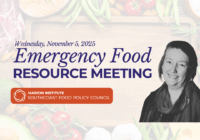
- Join the SFPC Emergency Food Resource Meetings to coordinate and organize food relief efforts.
- Contact your legislators and urge them to prioritize SNAP funding and food-security programs: https://malegislature.gov/Search/FindMyLegislator
- Support local initiatives that strengthen our food system—from farm-to-school programs, community gardens, gleaning programs, to your local Food Policy Council—so we’re less vulnerable to federal disruptions.
- Follow the “BUY NOTHING Community Food Share – Southcoast MA” facebook group whether you’re in need of food or have excess and want to help those in need.
Why This Matters
A government shutdown isn’t just a political impasse—it has real consequences for real people.
In a time when many households already struggle to afford groceries, even a short interruption in SNAP benefits can deepen hunger and hardship.
On the Southcoast, where nearly half of New Bedford’s households depend on SNAP and food insecurity rates are among the highest in the state, the stakes are especially high.
Together, we can support our neighbors, strengthen our local food system, and advocate for policies that ensure no one goes hungry in Massachusetts.
Resources
- Massachusetts SNAP Updates: https://www.mass.gov/info-details/november-2025-snap-updates
- Project Bread FoodSource Hotline: 1-800-645-8333
- The Greater Boston Food Bank GBFB.org/need-food
- The Food Bank of Western Massachusetts FoodbankWMA.org/get-help/
- Southcoast Food Policy Council at the Marion Institute https://www.marioninstitute.org/programs/sfpc/
- For up to date shutdown information on other benefits and emergency food resources, see MassLegalServices.org/Shutdown
Related Posts



This Post Has 0 Comments