
Reconnecting Food and Community
Our Mission:
The Marion Institute believes that food is a powerful connector and the foundation of health. Through partnerships, education, and community engagement, we are strengthening our local food system to ensure all people can access and enjoy health-promoting food.
Our Vision:
A thriving regional food system that supports the health of our communities, our land, and the relationships that sustain us.
Our Core Programs:
Grow Education – Farm-to-School
Grow Education improves student health and learning by embedding farm-to-school practices and food literacy in public education. Working in 27 Southcoast elementary schools and in 7 districts, the program builds school gardens as outdoor classrooms, co-creates curricula with teachers, and supports professional development. Students learn by planting, harvesting, and tasting food they grow, connecting science, culture, nutrition, and community in meaningful ways.
Frogfoot Farm – Neighbors Feeding Neighbors
Frogfoot Farm is a regenerative farm-to-food-relief initiative growing nutrient-dense produce for families experiencing nutrition insecurity. The farm donates thousands of pounds of food each year while serving as a learning site for students, volunteers, and partners to explore soil health, biodiversity, food justice, and climate-smart farming. Frogfoot Farm also trains volunteers for gleaning through our Fields to Families program.
Fields to Families – A Regional Gleaning Program
Fields to Families is a volunteer-powered gleaning program that rescues surplus produce from regional farms and distributes it to local hunger-relief partners. By compensating farmers for gleaned crops, the program reduces waste, nourishes residents, and strengthens farm viability — creating a circular model that supports agriculture, food access, and community connection.
Southcoast Food Policy Council
The Southcoast Food Policy Council convenes partners to address nutrition equity and food insecurity at the systems level. Through coalition-building, legislative advocacy, community engagement, data collection, and regional planning, SFPC elevates local priorities within statewide policy conversations and supports collaborative solutions that strengthen the Southcoast food system.
Greenhouse Initiatives
For over thirty years the Marion Institute has been the financial home of dozens of successful social change organizations. By providing fiscal sponsorship and administrative backing, our Greenhouse Initiatives enable an impressive array of visionary leaders to fully engage in the frontline implementation of their work, at every stage of growth and development.
OUR “GREEN” OFFICE
Green Building
Our office building is a renovated home and we utilized green building techniques in the renovation process. Green Building is the practice of increasing the efficiency with which buildings use resources – energy, water, and materials – while reducing building impacts on human health and the environment during the building’s lifecycle, through better siting, design, construction, operation, maintenance, and removal.
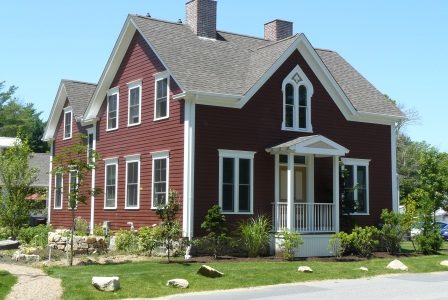
The Gurney House Green Restoration Project – October 2008
Only 15% of the entire 1 acre office campus, of which the Gurney House is part, is covered by impervious surfaces and adaptive and native plantings fill over 50% of the total site.The following is a short list of some of the key features that made the project green (click here for the full document):
- The high density spray foam insulation used is rated to have a standing R-Value of 6.8 per inch, but because it is able to prevent all air and moisture penetration it has an effective R-Value of 20+ per inch. This allows a relative R-Value rating of R-33 in the walls and R-60 in the ceiling.
- All appliances and fixtures including boilers, furnaces, AC condensers, refrigerator, dishwasher, and light fixtures are Energy Star rated.
- Operating windows on all sides of the building allow for natural cross breezes for passive cooling. The windows are double pane insulated glass, specially treated to be air tight and glazed with low E glass that helps suppress radiative heat flow.
- We weren’t sure what to do with the building’s exterior. We liked the look of faux stone siding, but in the end we chose a siding that is composed of natural raw and recycled materials including wood pulp, sand, water, and cement and is very low in toxicity. It offers great durability (the company warrants the product for 50 years, and the factory paint finish for 15 years), and low maintenance. It took us a while to learn about all of the Different Types Of Siding but we’re really pleased with how it turned out. We think it looks great!
- The resilient floors found in the restrooms and kitchens are high in recycled content and applied with non-toxic, low VOC emitting glues. Bamboo, a renewable natural material, was used in the lobby floor.
Sustainability
In a broad sense, sustainability is the capacity to endure. In ecology, the word describes how biological systems remain diverse and productive over time. For humans, it is the potential for long-term improvements in wellbeing, which in turn depend on the wellbeing of the natural world and the responsible use of natural resources.
In addition to living in a green building, we at the Marion Institute have implemented and continue to implement everyday practices that will make our office more sustainable. Click here to download the full document to green your home or office. We welcome all to come and visit our “green” office. We hope to see you soon!
“The Marion Institute provides support and insight to emerging initiatives that make a profound difference in the world. Their work does not show up at the head of the parade, but it is often the reason there is a parade at all.”
-Paul Hawken, environmentalist, entrepreneur, author


